Tuesday, 18 December 2012

Landstraße Hauptstraße Options

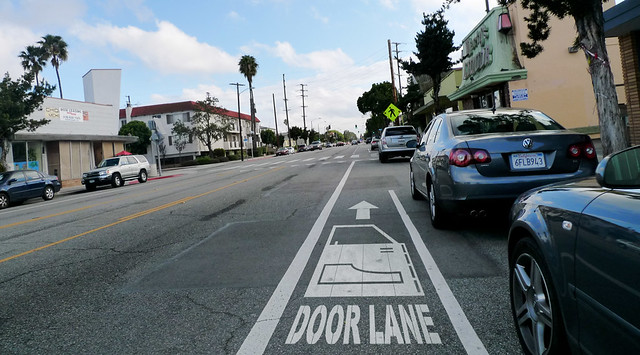
Most working days I commute to work along Landstraße Hauptstraße which is a busy shopping street, bus route, 50kmph through road with short term parking on both sides. It is a busy compressed space so as usual in Vienna the cycle infrastructure solution is narrow Mehrzweckstreifen forcing bikes into the Door Zone. The road markings were recently repainted and have introduced even more (slightly wider) Mehrzweckstreifen at the Northern end. I was so disappointed that I raised a complaint with the RadKummerKasten.

I was very happy to get a reply but the reply basically said the Door Zone was not a problem (it is), I am breaking the law if I try to protect myself by riding out of the door zone of death (debatable but I would rather be fined than seriously injured), cycle paths are dangerous (only if designed poorly) and this paint on solution is the result of 10 years work so do not expect change soon (10 years!).  There is too much in the response to get really angry about in just one blog post so this is maybe part 2 of a series...  However there was one fair point in the reply that stated my proposal to paint car doors in the Door Zone lane and not bikes was cynical and not constructive.

Despite being not the only person to get really frustrated with such terrible cycling infrastructure. I shall try to be constructive.

The problem with Landstrasse from a cycle traffic perspective is that it is a District Access Road which are very difficult roads to get right.  These types of roads have many functions and a clear strategy is not always obvious.

Here is a typical problem section of Landstraße Hauptstraße.  There is Parking both sides narrow  Mehrzweckstreifen and busy footpaths.  These Parking bays are short term so that means the car doors open a lot.  There are also many cars performing parking manoeuvres reversing into spaces and blocking bike and motor traffic.  There are many small trucks and vans delivering goods to the many shops and the local market. There is excellent public transport on this street with the U3 Underground running underneath and buses along the road.  At the North end of the Street is the new Wien Mitte railway station.

The road plan looks like this:

I think this road has a 50kmph speed limit but the road is so busy that it is hard to drive very fast.  Average speed for cars (despite some efforts to drive at well over 50kmph) is about the same as fast bikes here except in rush hour when it is a lot slower.  I cope with this road by riding very fast and aggressively but this is not pleasant, safe or something normal people will want to adopt as a daily routine. So the first obvious thing to do would be to lower the speed limit to 30kmph. This would greatly reduce the conflict with bikes and increase the safety of the many pedestrians without really affecting the average speed of motor traffic. 

This is also one of the main routes for district traffic.  Motor traffic reduction is the next obvious thing to do to make this a more pleasant shopping street.  This would maybe involve a one way system and modifying the surrounding streets.

There are many pedestrians and so the footpaths should not be any smaller. This is the main high street for the 3rd district and should be a nice place for people, with cafes, market and shops so the pedestrians should not lose space.

So how do you do a cater for bike traffic, pedestrians, 2 way 50kmph motor traffic and parking, on a shopping high street?  What would the Dutch Do?


You can  have a separated 2 way bike lane protected with bollards to stop it being used as a unloading/parking lane. This would reduce parking capacity although the other side of the road could become diagonal parking bays.  It creates a clear protected cycle path without door zone or taking space from pedestrians, However Junctions would be complex and very difficult. This option is a compromise that could work but it means all road users would have to compromise a bit.


The parking could be removed completely and one way cycle lanes put in. This would maintain the motor traffic capacity and allow the foot path to be made wider in some places and reduced in others.  It would make junction easier to design but Bus stops and loading bays are very problematical.


You could squeeze the cycle paths to the pedestrian side of the car parking.  This reduces dooring problems because most cars only have one occupant (the driver) who opens the door on the motor traffic side (so they probably look first because suddenly they are the vulnerable road user).  If a cyclist hits a passenger side car door they get thrown in front of pedestrians instead of 50kmph motor traffic, so serious injury is very possible but death is unlikely.


I can only conclude that separate cycle paths on this road are only possible with the reduction of parking, and even then they are not ideal.  I think a solution can only be a complex mix of dramatic traffic reduction, 30kmph speed limit, enforced with traffic calming structures and environment, parking space reduction and few loading bays for deliveries.  If this is done well then cycling along this road would be much more pleasant and this would be a step towards nice road to shop and be on.

So to answer my questions:

Q: How do you do a compromise and cater for bike traffic, pedestrians, 2 way 50kmph motor traffic and parking on a shopping street?
A: You can not.

Q: How would the Dutch compromise and cater for bike traffic, pedestrians, 2 way 50kmph motor traffic and parking on a shopping street?
A: They would not.  A shopping street is for shopping.

A quick Google search for shopping streets and StreetView yields:


The city of Vienna has a similar road design disaster problem with the biggest shopping street in Vienna Mariahilferstrasse.  This street is so busy that it has to close to motor traffic every December due to the number of Christmas shopping pedestrians that can not fit on the footpaths.  Next year it will finally be changed from a bidirectional main road with door zone cycle infrastrucutre and parking on boths sides to a proper shopping street so maybe there is hope.  Does Landstraße Hauptstraße have to wait for the situation to get so bad that 4 lanes of motor traffic space are reduced to zero, will this street become even more dis-functional as everyone takes the U3 a few stops to Mariahilfe to do their shopping, or do the local politicians have the courage to realize that they are there to represent local  people and businesses not motor cars?

Monday, 10 December 2012

Share the Cycle Path

Pedestrians belong and have a right to walk on the footpath.  The problem of Conflict between Pedestrians and Cyclists can be easily solved if there is a Vienna wide walking pace speed limit for cyclist that is strictly enforced by the Police with hefty fines. Cyclists need to change their attitude and be more patient with other users of the public space.

The above may sound logical to little old ladies who are angry by the young cyclist that whizzed past them on the  Cycle / Pedestrian shared use path. However most cyclists (I hope) will find this ridicules and oppressive of their rights and needs.

However a lot of cyclists seam to think the same about the solution to the car and cyclist conflict.  Why on earth should a car driver be patient with cyclists when those cyclists are not prepared to be patient with them once they get out their car and become a pedestrian?  Is a modern city a city that has cars limited to bike speed or bikes limited to pedestrians speed, or is this one group trying to oppress others?

Behavior is extremely important and we all have to be patient and tolerant of others but when others ignore you and impose their needs on you that is not sharing it is dominating which results in conflict.  Now it is fair to say that cars have dominated and imposed their needs on the public space unfairly for the last 50 years.  But now it is time for pedestrians and cyclist to win some space back.  We will not do this trying to oppress others into unnatural behavior.

We need road design that understands the needs of the users and incorporates this into the engineering. Yes lets share the road when traffic volume is low and speed is below 30kmph.  But on Main through roads there will only be conflict if cyclists (perhaps rightly) claim their space in the way of fast moving cars.  Yes we need space which can come from parking or traffic lanes but mixing will not work if there is large amounts of fast moving motor traffic.

So rather than trying to control others behavior lets look at road design and engineering strategies that  remove conflict and make a safe and pleasant environment for cyclists pedestrians and motorists.

Monday, 3 December 2012

The Future of Cycling Advocacy: Stop listening to cyclists.

People who cycle now in low modal share cities to not understand non-cyclists.  They have developed strategies to cope with the road environment but do not understand why these strategies are not attractive to others.

We need to make our cities better, but not for existing cyclists. We need to make them better for the non-cyclists.  The kids who get driven to school, the drivers that waste hours each week in traffic jams, the unfit or overweight people who are not able to fit regular exercise in their daily routine, the road accident victims and their families, the people with poor health due to poor of air quality, the pedestrians who are scared by cyclists on the foot path, and the pedestrians who can not get across the road.

This blog post from the Cycling Embassy of Great Britain is a perfect example of a person that would benefit from good quality cycling infrastructure.  Rational, practical and inclusive, rather than religious and elitist.

A non-cyclist's view of cycle campaigning

There is a shift in cycle campaigning that is gaining momentum by not focusing on cycling but people friendly modern cities. These guys are well worth listening too.


Sunday, 18 November 2012

Door Zone

The Door_zone wiki page suggests that 12% of injuries and 3% of fatalities are a result of the Door Zone "accidents". It is common advice to cyclists that you should cycle outside the door zone.

Vienna has 51 km of Mehrzweckstreifen which are normally narrow and along the side park cars, and many cyclists have a dooring or near miss dooring story to tell.

Cyclists develop strategies to cope with these uncomfortable types of road. My strategy is to ride out away from parked cars for 2 reasons. One I try to give myself space to react to pedestrians who step out or opening car doors. The other reason is to slow overtaking traffic down so that they have to do a proper overtake rather than speed on past with no reaction time to my obstacle avoiding swerves. This technique is not understood or very appreciated by some drivers who use their horn and punishment passes to bully me out the way. It is also of questionable legality although cyclists do have the right to leave a safe distance to dangerous objects which is what I am trying to do.

I do use these zones to filter through stationary traffic but I do so at very low speed to give me reaction time. The faster I ride the further out I ride, and I try not to swerve in and out as parking bays change as that can confuse car drivers. This judgement comes with age and is easier if your ride fast to minimise the inconvenience to potentially overtaking cars.

Here is a video of a cyclist in Vienna using these kind of Mehrzweckstreifen (or rather not being able to use these kind of Mehrzweckstreifen.  Note that the diagonally parked cars do not have the door problem but there is still a danger from pedestrians stepping out.)


Certainly being doored or worried about being doored does not contribute to the pleasant, convenient and comfortable design criteria for good quality cycling infrastructure.  As cycling becomes a more common and important part of mobility in developed urban countries the Door Zone problem needs to be solved.

This is the Austrian non-solution:


The Americans are developing solutions:

How would the Dutch Solve this issue?

Thursday, 8 November 2012

Proper CROWizing.


It seems cycle campaigning is gaining momentum in London and this conference is evidance that things are started to get professional.

One presentation that I really like was a proper Dutch engineer doing some CROWize London Consultancy.

Presentation can be downloaded here.


I really hope the day comes when this CROWize Vienna Blog is replaced by proper consultants and quality design and implementation.

Monday, 5 November 2012

Welcome to the age of the bike.

As a Brit living Vienna I was very excited about The Times Cycling Campaign when if first was made public because it was a big sign that Cycling in Britain Goes Mainstream.  Their 8 points were nice but focused on symptoms without really understanding the problem.  For example fitting mirrors to trucks is a good idea but will not really make it pleasant for a 10 year old cyclists to share the road with them.  However the Times have stuck at it and are relaunching their initiative and if this article is anything to go by they are really on the right track.

Austria did a better job with its 10 point manifesto, and in terms of Cycle usage and  infrastructure is well in front of the UK.  However Vienna is way behind where it could be potentially.

This all just confirms to me that the world is changing and the bike is a big part of the answer for the foreseeable future of urban mobility.  So I hope the focus in Vienna also changes to infrastructure quality because that is where I see the biggest barrier to utility cycling by a large proportion of the population.

So please to check out and support  The Times Cycling Campaign and lets hope this political realisation is contagious.


Monday, 22 October 2012

Radwegebenützungspflicht

Radwegebenützungspflicht is the compulsory use of cycle infrastructure. It is a law in Austria that cyclists must use the cycle infrastructure if there is some near by (or something like that but it is a bit unclear...).

Some cyclists oppose this law for various reasons but here are some that are plausible arguments IMHO:

- It was introduced to get bikes out of the way of cars.
- Cyclists should have the right to ride fast on the road and not be forced to use the slow poor quality dangerous cycle paths with all the pedestrians, "beginner" cyclists and hazards.
- It re-enforces the cultural opinion that bikes have no right to be on the road.


Statements like these demonstrate these attitudes:

"Schnelle Radler können im Verkehr mitschwimmen und Langsamere oder Ängstliche haben es am Radweg gemütlicher."

One thing I am 100% sure of, if this law is dropped then overnight absolutely nothing will change for 99% of road users. The road environment will still be the same aggressive environment and the cycling infrastructure will still be of poor quality. 8 year old children will not suddenly start riding to school mixing with the 50kmph cars. A few cyclists can run will the bulls with the legal right to be there and can feel superior to all the afraid beginners, but the environment that would enable high levels of cycling will not be any closer.

I personally like adrenalin and going fast. I race extreme sailing boats and ride my mountain bike down hill faster than I really know how too, but I would like to think I can make the differentiation between sport and practical, responsible mobility.

So lets get rid of the Radwegebenützungspflicht so cycle campaigners can focus on the important stuff.